
The ACER Disability Inclusion Action Plan (DIAP) 2023 – 2026 represents the first such plan focussed on disability inclusion and accessibility for ACER. The development of the DIAP reflects ACER’s commitment to creating a socially just, accessible and inclusive environment for people living with disability, as well as its adherence to relevant legislative requirements. ACER affirms that all people living with disability have a right to equitable access — be they clients, candidates, employees or visitors.
ACER acknowledges the guiding principles of the United Nations Convention on the Rights of Persons with Disabilities (CRPD)1 and accepts the bio-psycho-social model of disability adopted in the Convention:
“Disability is an evolving concept and disability results from the interaction between persons with impairments and attitudinal and environmental barriers that hinders their full and effective participation in society on an equal basis with others.” 2
In line with the UN CRPD, ACER supports a broad definition of people with disability, which includes:
ACER also acknowledges those who may not identify as living with a disability, but who may be positively impacted by this plan – such as people with lived experience of neurodiversity, mental health issues and chronic health conditions; the Deaf Community; primary carers of people with disabilities; and other people whose lives are affected by those living with disabilities.
The World Health Organisation (WHO) estimates that around 1 billion people live with disability. This corresponds to around 15% of the world’s population, with that number increasing due to ageing populations and increases in chronic illness. WHO further recognises that the obstacles experienced by people with disability may be compounded by other systemic exclusions experienced by people, including those based on age, ethnicity, gender identity, culture, religion, sexual orientation, First Nation status and other attributes.
In developing this plan, ACER commits to minimising and removing attitudinal and environmental barriers to participation across the organisation, and to creating a positive, inclusive, and accessible environment. The Disability Inclusion Action Plan 2023 – 2026 represents a significant step toward achieving ACER’s aspiration to be a leader in disability inclusion and accessibility.
The ACER Disability Inclusion Action Plan 2023–2026 identifies four priority areas:
2 Preamble: https://www.un.org/disabilities/documents/convention/convention_accessible_pdf.pdf
The Disability Inclusion Action Plan has been developed within the following legislative contexts, aligning with ACER operational locations.
Australia:
Disability Discrimination Act (DDA) 1992 (Cth)
Disability Standards for Education 2005 (Cth)
India
Rights of Persons with Disabilities Act 2016
Malaysia
Persons with Disability Act 2008
United Arab Emirates
Federal Law No. (29) of 2006 Concerning the Rights of People with Special Needs
United Kingdom
Equality Act of 2010
ACER acknowledges that its work has global reach and commits to ensuring that the work aligns with local legislative requirements in relation to anti-discrimination and disability inclusion where that differs from the above.
Development of the DIAP was undertaken in consultation with stakeholders across the organisation through the Disability Advisory Committee (DAC), which comprises:
Consultation was also undertaken with the operational leaders responsible for actions within the plan.
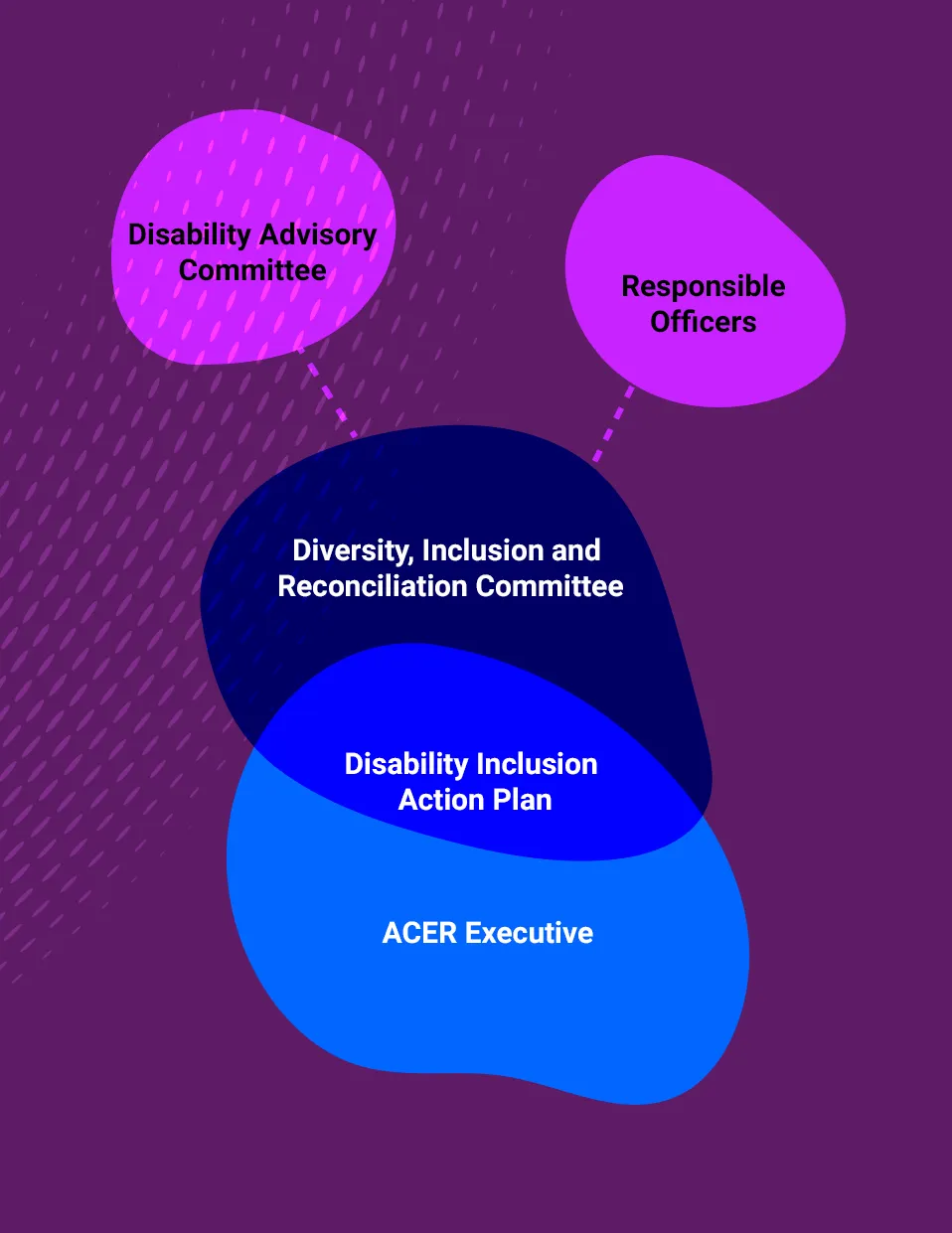
Responsibility for implementing the DIAP is shared across the organisation. Representatives from operational areas (responsible officers) who are accountable for implementing actions on the plan will report on progress to the ACER Diversity, Inclusion and Reconciliation Committee, comprising senior executive staff representatives.
The ACER Diversity, Inclusion and Reconciliation Committee will provide monitoring and oversight of the DIAP, advising on resourcing implications, and will provide bi-annual reporting to ACER Executive.
The Disability Advisory Committee will provide advice and feedback on implementation of DIAP actions to ensure that the perspectives of staff with lived experience of disability are central to decision-making, aligning with the ethos of ‘nothing about us, without us.’
Communication about progress on the plan will be provided on a bi-annual basis to the organisation via the ACER Intranet.
GOAL 1 ACER is known as a welcoming and supportive place for staff, test candidates and visitors who have a disability or mental health condition, are neurodiverse, are primary carers and/or are living with a chronic health condition.
GOAL 2 ACER demonstrates its commitment to disability inclusion and accessibility
* Refers to actions which encompass accessibility and disability inclusion, but which also have a broader Diversity and Inclusion focus.
GOAL 1 ACER ensures that its digital and physical environment are inclusive and accessible through a program of continual improvement
GOAL 2 ACER provides an assessment experience that is equitable, inclusive and actively supports candidates with disabilities
GOAL 3 ACER’s physical environment is safe, navigable, accessible, and inclusive for staff, candidates and visitors of all abilities
1 A human-rights by design approach to technology is defined by the Australian Human Rights Commission as “a systematic process for embedding human rights standards and compliance into the design, development and deployment of new technologies.” (Reference: Human Rights and Technology Final Report 2021: https://humanrights.gov.au/our-work/rights-and-freedoms/publications/human-rights-and-technology-final-report-2021)
2 WCAG 2.1 AA to be used as minimum standard, wherever possible.
GOAL 1 ACER uses a best practice approach to assessment design that incorporates Universal Design for Learning (UDL) and other inclusive frameworks or pedagogies
GOAL 2 ACER provides an assessment experience that is equitable, inclusive and actively supports candidates with disabilities
GOAL 3 ACER actively promotes and demonstrates best practice disability inclusion, accessibility principles and co-design in research
GOAL Prospective, new and current staff with disabilities are supported to thrive and succeed in their work at ACER
Accessibility
The term accessibility can be applied in a range of contexts – the physical and digital environment, products and services. Accessibility can be measured by the capacity for a person with a disability to navigate, engage with, use and/or participate without impediment on an equitable basis as a person without a disability.
Inclusion
Inclusion is the way an organisation’s culture, values, workplaces and behaviours make a person feel valued, included and able to participate fully. It relates to an environment where all people are treated fairly and respectfully, with equity of opportunity.
Membership of Diversity, Inclusion and Reconciliation Committee:

Lisa Scott, 2018
Biography and storytelling are cornerstones of Lisa’s discipline.
She has exhibited widely (Underbelly Arts Festival, Sydney Contemporary, et al.) and her works are held in numerous public and private collections across Australia, including a key acquisition by the University of Technology, Sydney.
The owl symbolically connects to ideas around knowledge and wisdom aligning with the core work of ACER. The capacity for flight is reflective of the expansive freedom inherent in education.
Studio A is a supported studio based in Sydney that tackles the barriers artists with intellectual disability face in accessing conventional education, professional development pathways and opportunities needed to be successful visual artists. This Social Enterprise paves professional pathways for such artists so that they can achieve their artistic and economic aspirations.
Studio A provides its artists with a working studio space equipped with specialist materials and support staff. It also manages an annual exhibition program and facilitates weekly workshops provided by invited contemporary artists.
Studio A supports a variety of artists working within a range of disciplines and strategically links Studio A artwork with an equally diverse range of target markets including art, design, craft, and corporate markets.

